
If one perfume contains 20% fragrance oil and another contains 35%, surely the 35% perfume must be stronger, better and longer lasting.
It sounds logical.
It is also a much simpler answer than the reality of perfumery.
Perfume concentration is important, but it is only one part of a much bigger formula. Two fragrances can have completely different concentrations and still perform very differently on skin.
A well constructed 19–20% Eau de Parfum can easily give excellent longevity and projection, while a 30% or 35% fragrance may sit closer to the skin, develop differently or even become less noticeable to the wearer after a few hours.
So before choosing a perfume simply because one brand prints a bigger percentage on the bottle, it is worth understanding what that number actually tells you.
And, just as importantly, what it does not tell you.
What does 20%, 30% or 35% perfume concentration actually mean?
The percentage normally refers to the amount of fragrance concentrate used in the finished perfume.
Very simply, a fragrance might contain perfume concentrate together with alcohol and other permitted ingredients.
So yes, a perfume containing 35% fragrance concentrate contains a greater proportion of fragrance material than one containing 19–20%.
That part is simple.
What does not follow automatically is:
35% lasts longer than 20%.
35% projects further than 20%.
35% uses better ingredients than 20%.
35% smells more similar to the fragrance it is inspired by.
35% is better made.
35% is safer.
35% is higher quality.
Those are completely separate questions.
It is a little like judging coffee only by how many grams of coffee were used without asking which beans were used, how they were roasted, how they were ground or how the coffee was brewed.
The number matters. It just does not tell the whole story.
Does 35% perfume last longer than 20%?
Not necessarily.
How long a perfume remains detectable depends on the actual fragrance formula and the behaviour of the individual materials inside it.
Some fragrance molecules are extremely volatile and disappear relatively quickly. Others evaporate much more slowly and can remain detectable for many hours.
Citrus materials, for example, behave very differently from many woods, musks, resins and amber materials.
The balance between top, heart and base notes matters.
The volatility of individual materials matters.
The interaction between those materials matters.
Fixatives and longer lasting molecules matter.
Your skin matters too.
Scientific research into fragrance evaporation from skin shows just how complex this process is. Researchers study fragrance release in the air above the skin because evaporation depends on the physicochemical properties of the individual fragrance molecules, their interactions and the surface they are applied to.
That means a beautifully balanced 19–20% perfume can remain noticeable for longer than a poorly balanced fragrance containing substantially more concentrate.
Simply adding more concentrate does not magically change the volatility of every molecule inside it.
Stronger and longer lasting are not the same thing
This is probably the biggest misunderstanding around perfume concentration.
When somebody says a perfume is “strong”, what do they actually mean?
Do they mean how much fragrance concentrate is inside the bottle?
Do they mean how strongly you smell it immediately after spraying?
Do they mean how far it projects from the body?
Do they mean the scent trail it leaves behind?
Or do they mean that a faint trace can still be detected on the skin eight hours later?
Those are different things.
A fragrance can last a very long time while remaining relatively close to the skin.
Another fragrance may produce a large scent cloud for the first few hours but fade sooner.
That is why concentration alone is a poor way to predict how a fragrance will actually behave when you wear it.
More fragrance oil can sometimes mean less projection
This sounds counterintuitive, but it is another reason why simply chasing the highest percentage can be misleading.
Alcohol is not just cheap liquid added to “water down” perfume.
Ethanol is widely used in fine fragrance because it is an effective solvent for fragrance materials and is highly volatile. Scientific research into perfume evaporation commonly studies fragrance molecules diluted in ethanol precisely because the carrier and the individual molecules influence how fragrance is released from a surface and into the air.
When a perfume is sprayed, the alcohol evaporates and helps create the initial diffusion of fragrance into the surrounding air.
Change the ratio of concentrate to alcohol and you can change the way the fragrance develops and diffuses.
This is one reason an Extrait de Parfum can feel richer, denser and closer to the skin, while a well formulated Eau de Parfum can sometimes create a more noticeable scent cloud around the wearer.
That does not make one format better than the other.
It means they can behave differently.
Projection and longevity should not be confused with the percentage printed on the bottle.
So why does Blossom Perfumery use around 20%?
Because our goal is not to produce the biggest number we can put into an advert.
Our goal is to make perfume that smells good, performs well, develops properly and can be worn comfortably as an everyday fragrance.
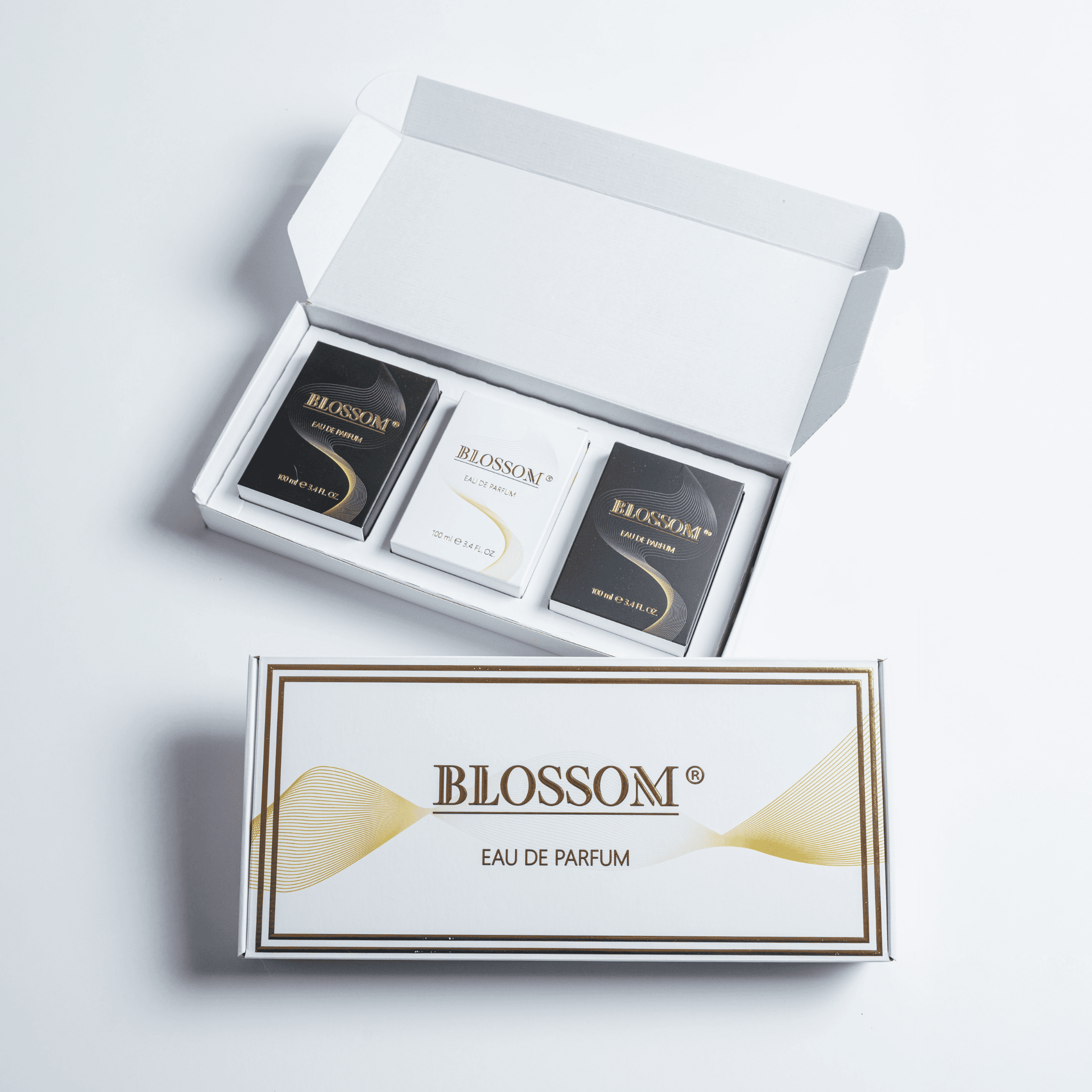
Blossom fragrances are Eau de Parfum strength, formulated at around 20% fragrance concentration.
We believe that a good fragrance should have balance.
Enough concentration to provide strong performance.
Enough volatility to allow the fragrance to open and project.
A formula that develops properly from the opening through to the drydown.
And, most importantly, a formula that has been assessed as a complete finished cosmetic product rather than judged by one marketing number.
That last point matters more than many perfume buyers realise.
Aromara 35% vs Blossom Perfumery 20%
Aromara promotes its fragrances as 35% Extrait and describes this as the stronger option compared with Blossom’s Eau de Parfum. It also states that having more perfume per spray is the mechanism behind longer wear.
In fact, we think brands should be transparent about their products.
But we disagree with the idea that comparing 35% with 20% is enough to tell a customer which perfume is stronger or which will perform better.
Does Aromara disclose a higher concentration than Blossom?
Yes.
Does that automatically prove that it will project more strongly?
No.
Does it prove that every Aromara fragrance will last longer than every Blossom fragrance?
No.
Does it prove that the ingredients are more expensive or higher quality?
No.
Does it tell you how accurately the fragrance has been constructed?
No.
And does the percentage alone tell you whether the finished product is safe?
Definitely not.
A concentration percentage is useful information.
It should not be treated as a performance score.
Does a higher concentration mean happier customers?
Not necessarily.
If a higher fragrance concentration automatically meant a better perfume experience, you might expect brands using the highest percentages to consistently receive the strongest customer ratings.
In practice, that is not what we see.
At the time of writing, Blossom Perfumery holds a 4.7 out of 5 rating on Shop, based on around 6,700 customer reviews, while Aromara, which promotes its fragrances at 35% concentration, holds a 4.2 out of 5 rating from 187 reviews.
Of course, a store rating reflects more than perfume longevity alone. Customers also judge scent accuracy, value, packaging, delivery and customer service.
But that is exactly the point.
Customers do not experience perfume as a percentage on a label. They experience the finished product.
A higher oil concentration may sound impressive, but it does not guarantee that a customer will prefer the fragrance, find it longer lasting or feel that it offers better value.
Blossom uses around 20% fragrance concentration, yet thousands of customers rate the overall experience very highly, with many individual reviews specifically mentioning strong longevity and all-day wear.
This is why we believe fragrance quality should be judged by the complete product rather than by one headline number.
Aromara: 35% → 4.2 / 187 reviews*
Blossom: ~20% → 4.7 / 6,700 reviews*
* Source: shop.app
Is 35% perfume concentration legal in the UK?
This is where the subject becomes particularly important.
There is no general UK law saying that a perfume becomes illegal simply because it contains more than 20% fragrance concentrate.
Extrait de Parfum is a recognised cosmetic product type, and a properly formulated 35% perfume can absolutely be legal and safe.
But there is an important condition.
The finished formula at that concentration must be safe and compliant.
In Great Britain, a cosmetic product must undergo a safety assessment before being placed on the market. A qualified safety assessor must prepare a Cosmetic Product Safety Report, commonly known as a CPSR, and the safety assessment has to consider the actual quantitative formulation and exposure to the individual ingredients in the finished product.
The Responsible Person must also maintain a Product Information File, follow good manufacturing practice, and notify the cosmetic product to the Office for Product Safety and Standards before it is made available to consumers in Great Britain.
That is very different from simply saying:
“Our perfume contains 35% oil, therefore it is better.”
Why increasing concentration is not always as simple as adding more perfume oil
A fragrance concentrate can contain many different fragrance materials.
Some are unrestricted at the levels normally used.
Others have specific restrictions.
Some materials are controlled because of concerns including skin sensitisation or systemic toxicity.
IFRA Standards can prohibit certain fragrance materials, restrict the maximum amount that can be present or impose specifications on how they can be used.
Most importantly, IFRA explains that restrictions are calculated according to the concentration of a restricted fragrance material in the finished consumer product.
That distinction matters.
Imagine a fragrance concentrate containing a restricted material.
If exactly the same concentrate were used at 20% and then increased to 35%, the amount of that material in the finished perfume would also increase substantially.
Depending on the formula, that could mean the fragrance needs to be reformulated before a higher concentration can safely or compliantly be used.
It does not mean that every 35% perfume is unsafe.
It means that each fragrance formula needs to be assessed individually at the concentration in which it is actually sold.
There is no sensible scientific reason to assume that every fragrance should have exactly the same maximum concentration.
Different perfumes contain different materials in different amounts.
What about perfume allergens?
Fragrance allergens are another reason why concentration needs more thought than simply asking “how much oil is inside?”
Some fragrance ingredients can cause allergic contact dermatitis in people who are sensitised to them.
The European Commission has expanded individual labelling requirements for fragrance allergens, with specified allergens having to appear individually in ingredient lists when they exceed relevant thresholds in leave on cosmetics.
IFRA also maintains restrictions for numerous fragrance materials based on scientific safety assessments. Depending on the material, restrictions can relate to effects such as dermal sensitisation or systemic toxicity.
Again, this does not mean high concentration perfume is inherently dangerous.
It means responsible perfume formulation requires considerably more work than simply deciding that 35% sounds better than 20%.
Can perfume cause a skin reaction?
Any fragranced cosmetic has the potential to cause a reaction in a sensitive individual.
That includes expensive designer perfume, Eau de Toilette, Eau de Parfum and Extrait.
According to NHS guidance on contact dermatitis, symptoms of irritant contact dermatitis can include dryness, redness, burning or stinging. Allergic contact dermatitis can include redness, itching, cracked skin and a stinging sensation. More severe reactions can involve blistering.
Fragrance ingredients are also recognised triggers of allergic contact dermatitis in sensitised individuals.
This is exactly why we believe safety assessment should be part of the conversation when brands discuss concentration.
A bigger percentage should never be treated as automatically better.
How Blossom approaches perfume safety
At Blossom Perfumery, formulation and compliance are not an afterthought.
We work with specialist regulatory companies, qualified assessors and laboratories to ensure our perfumes meet the requirements for the markets in which they are sold.
The actual fragrance composition is considered.
Restricted ingredients are considered.
Allergen levels are considered.
The finished concentration is considered.
Stability is considered.
Packaging is considered.
And the finished product is documented and assessed before being placed on the market.
UK cosmetic safety requirements specifically require the safety documentation to consider the quantitative and qualitative composition, physical and chemical characteristics, stability, impurities, packaging material, exposure to the product, exposure to individual substances and their toxicological profile.
That is what meaningful perfume safety looks like.
Not just a percentage on the front of an advert.
Even the bottle and atomiser matter
This part is rarely discussed in perfume marketing.
The perfume formula is only one part of the finished product.
The bottle, atomiser, seals and other materials that remain in contact with the perfume also need to be suitable for their intended purpose.
UK cosmetic safety documentation specifically includes packaging material among the factors that must be considered, alongside product stability.
At Blossom, we take this seriously.
Packaging compatibility, bottles and atomisers form part of our ongoing quality and laboratory work because we want the perfume reaching the customer to be the same product that was originally assessed and intended.
A perfume is not just fragrance oil in a percentage.
It is a finished cosmetic product.
What should you compare instead of simply comparing 20% with 35%?
Start with the most obvious thing.
Wear the perfume.
How does it smell after 30 minutes?
How does it smell after three hours?
Can somebody standing next to you still smell it?
How does the drydown compare with the fragrance you wanted?
Do you actually enjoy wearing it?
Then look beyond concentration.
Look at the consistency of customer feedback.
Look at how long the company has been selling its products.
Look at whether the company provides proper ingredients and allergen information.
Look at the product range.
Look at the sizes available.
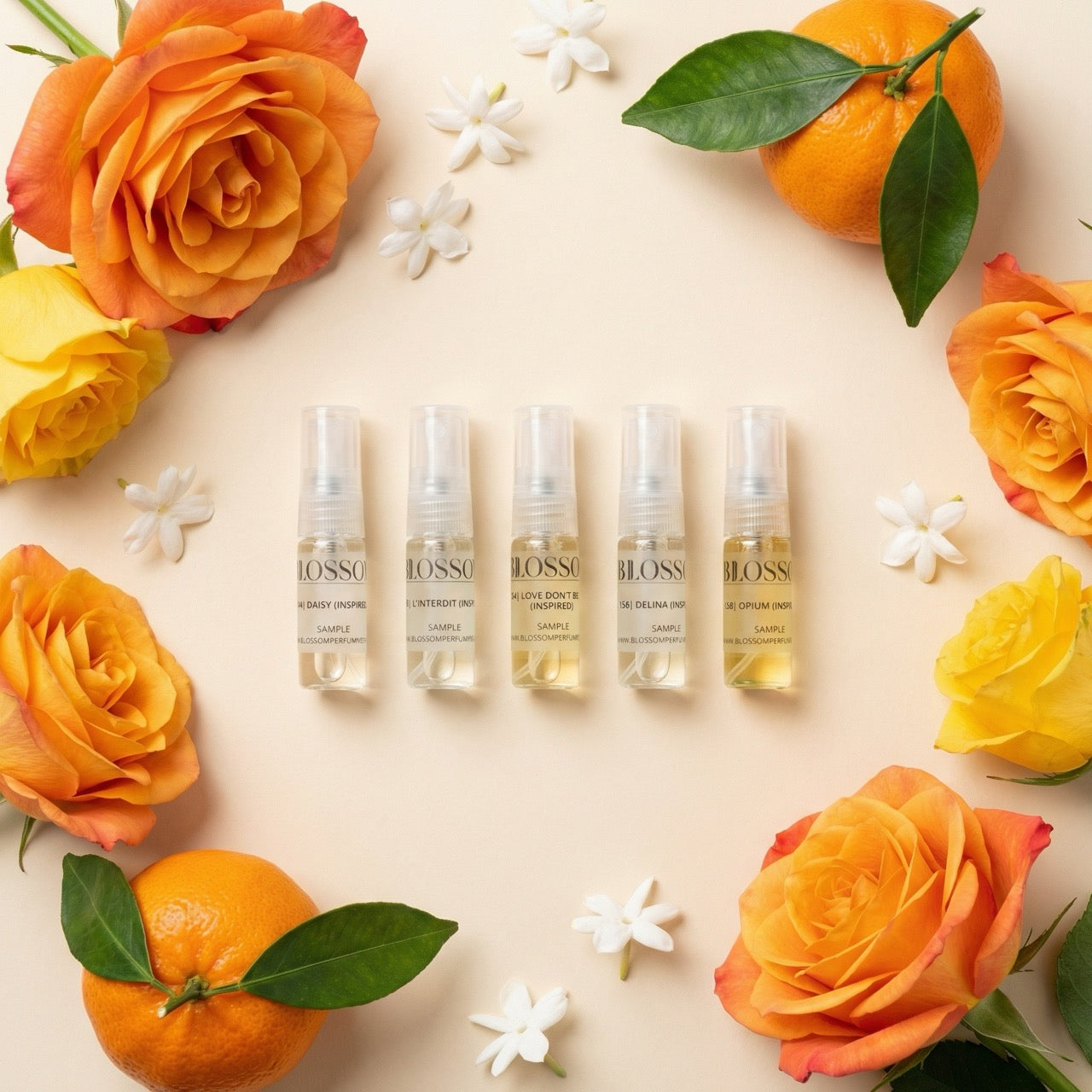
Look at whether samples are available before committing to a full bottle.
Look at customer service.
Look at price per usable bottle, not simply the amount of concentrate.
And look at whether the business is transparent about how its products are made and assessed.
Those things tell you far more about a perfume company than one percentage.
What do real Blossom customers say?
Concentration claims are made by brands.
Performance is experienced by customers.
At the time of writing, Blossom Perfumery has more than 6,500 customer reviews, with an overall rating of 4.8 out of 5 and approximately 90% of customers rating the company five stars.
Many individual fragrance reviews specifically mention longevity, scent similarity and receiving compliments while wearing the perfumes.
Reviews are not a replacement for laboratory assessment or proper cosmetic compliance.
But thousands of customers wearing fragrances in everyday life provide something a concentration percentage cannot provide.
Real world experience.
Does that mean 20% is always better than 35%?
No.
And we think that is exactly the point.
We would be making the same mistake if we claimed that 20% is automatically better simply because Blossom uses it.
A great 35% fragrance can be excellent.
A great 20% fragrance can be excellent.
A poor 35% fragrance can still be poor.
A poor 20% fragrance can still be poor.
The percentage alone cannot tell you which one you are holding.
Perfume formulation is about balance, not a competition to print the biggest number on the bottle.
The question perfume buyers should really ask
Instead of asking:
“Which perfume has the highest oil percentage?”
Try asking:
“Which perfume gives me the best combination of scent, similarity, projection, longevity, comfort, safety, consistency and value?”
That is a much more useful question.
At Blossom Perfumery, we use Eau de Parfum strength at around 20% because we want that balance.
We could market perfume by turning concentration into a numbers race.
We would rather let the finished fragrance do the talking.
Explore our Eau de Parfum collection and judge for yourself.
Frequently Asked Questions
Is 35% perfume stronger than 20%?
It contains a higher proportion of fragrance concentrate, but that does not automatically mean it will smell stronger to the wearer, project further or last longer. Performance depends on the complete formulation, the volatility of individual fragrance materials and how the fragrance behaves on skin.
Does more perfume oil mean longer lasting perfume?
Not automatically. Some fragrance materials evaporate quickly while others remain for much longer. A balanced 20% formula containing long lasting materials can perform better than a higher concentration formula built differently.
Can an Eau de Parfum last longer than an Extrait de Parfum?
Yes. Concentration is only one factor affecting longevity. The actual fragrance composition and individual materials can make a significant difference.
Does Extrait de Parfum project more than Eau de Parfum?
Not necessarily. Extrait can sometimes feel richer and denser while sitting closer to the skin. Eau de Parfum can provide excellent diffusion and projection because the relationship between fragrance materials and the volatile carrier affects how the scent is released.
Is 35% perfume concentration safe?
It can be. There is no general rule saying 35% perfume is unsafe. However, the finished formula must be assessed at that concentration and must comply with applicable cosmetic safety requirements and ingredient restrictions.
Is perfume above 20% illegal in the UK?
No. Extrait de Parfum is a recognised cosmetic product category. What matters is whether the specific finished formulation is safe, properly assessed, documented, labelled and notified in accordance with UK cosmetic regulations.
Why does Blossom Perfumery use around 20% fragrance concentration?
We formulate our fragrances at Eau de Parfum strength to achieve a balance between longevity, projection, fragrance development and everyday wearability while ensuring each finished formula meets the safety requirements applicable to it.
Is a higher perfume concentration better quality?
No. Concentration tells you how much fragrance concentrate has been used. It does not tell you the quality or cost of the materials, how accurately the fragrance has been constructed, how it performs on skin or how well the finished product has been made.
Final thoughts
There is nothing wrong with a perfume brand proudly stating that its fragrance contains 30% or 35% concentrate.
Transparency is a good thing.
The problem begins when a concentration figure is presented as if it answers every other question about the perfume.
It does not.
35% tells you that there is more fragrance concentrate in the bottle than 20%.
It does not automatically tell you that the perfume lasts longer.
It does not tell you that it projects further.
It does not tell you that it uses better ingredients.
It does not tell you that it is more accurate.
It does not tell you that it is safer.
And it certainly does not tell you which perfume you will prefer wearing.
Good perfumery is about the complete formula.
Sometimes, more really is more.
And sometimes, better balanced is simply better.